OFFER: A BRAND NEW SERIES AND 5 FREEBIES FOR YOU!
Grab my new series, "Brave Hearts of the Frontier", and get 5 FREE novels as a gift! Have a look here!
Chapter One
Texas, 1871
A knock midday during spring roundup could mean anything. Eliza Mae wasn’t expecting visitors, and the echo through the little clapboard house broke her concentration. She nearly stabbed her sewing needle straight into her finger. She quickly set the pair of honey-hued tweed trousers aside and popped her finger into her mouth to suck the drops of blood away from the tip.
“Ma?” Henry perked his head up from the corner of the room, where a whole herd of carved wooden horses sprawled strategically on the rough wooden floorboards in front of him.
“Keep on playing,” Eliza Mae instructed. “It’s probably just more work for me.”
Her insides were a roiling mass of twisted knots. She did her best to look put together and not let her frayed emotions show on her face, but it was hard when every knock took her straight back to the day that her world imploded.
An accident. A horse fallen over backward. Samuel gone.
For nearly a month, Eliza Mae had lived in a suspended state of indecision and grief. She’d learned long ago that grief wasn’t just made of sadness. It was pain laced with anger, bitterness, and the bleak gray coating of helplessness that settled over the world like ashen storm clouds.
She pulled open the door, expecting one of the many vaqueros who gathered for the roundup and the drives to be standing on her little wooden porch wearing a bashful expression and sporting an armful of torn clothing.
Eliza Mae blinked at the two tall men. Strangers both, but that was no surprise. In the spring, Winsome was more dust and strangers than it was a town. When the cattle, horses, and men moved out, the town would be nothing more than a collection of scattered clapboard buildings, a near-empty general store, and wind-whipped ghosts.
No one profited more than the suppliers, though Mr. Abrams was a good man. He’d thrown his stone not far from San Antonio and settled on the first patch of good land and fast flowing water that he came to. Winsome, because in life, you lose some and you win some, and he thought it was winning patch of ground.
He had dreams and a little bit of cash to sink into supplies, and within two years, he’d turned his general store into a thriving business. It wasn’t so hard to do when the demand not just for supplies, but for horses and mules, seemed to reach a new high every spring.
“Good day, Mrs. Whitcomb.” Both men were tall, with dark hair. The one who spoke first had a mustache that twitched with every word. He extended a massive gloved hand.
They were both broad and well dressed, though their frock coats, gloves, impeccable linen trousers, and tall black silk top hats made them seem about as out of place in Winsome as a circus lion would have been. The drives attracted all types, but this was a first for Eliza Mae.
“Good afternoon,” she forced out past a dry mouth. She instinctively stepped out onto the porch and shut the door behind her, though she couldn’t say what instinct it was. Texas was powerful hot, even in spring, but that wasn’t the reason her palms grew damp. She clasped her hands together and did her best to swallow back her fears and hold her head high. “What can I do for you?”
“We’re here to discuss the matter of a debt.” The man’s mustache leaped again. He grinned at her, and despite his expensive, tailored clothing, his mouth was full of rot. “Your husband left San Antonio owing a certain establishment a large sum of money.”
Shock hit Eliza Mae like a runaway longhorn. Shock, and a terrible inkling of understanding, truth edging around those hard words. Samuel. Why? It suddenly made sense why he’d been in such a hurry to leave. It wasn’t the first time they’d picked up and left everything behind. They’d done it far more times than she could count over the years, always pushing farther and farther west.
She’d believed her husband when he’d explained that he wanted to get to Winsome as fast and early as possible so he could get hired on for one of the many cattle drives.
It went against what he’d argued for in the first place, which was San Antonio, a place to set herself and Henry up while Samuel was away for months, a place where she’d have work and Henry could go to school. A place that maybe, for once, felt rooted.
Sam had argued and argued for Winsome, said he’d only just learned about it and that it was easier to get hired on there, and more organized than the chaos of San Antonio.
“Mr….” Eliza Mae began, but trailed off at the absence of a name.
“James.”
That wouldn’t do. These weren’t the kind of men you addressed by their Christian name. They exuded menace in their wide stance, their broad shoulders, and the gleam sparking in the dark depths of their eyes.
They were both deeply tanned, both with eyes so black and a bone structure so rigid, noses so near identical, that they seemed to have been carved out of the same stone. Brothers, likely. Or just brothers united in a common cause, none of it good or legal.
“Yes, but…”
“Just James. And this be Harold. Also just Harold.”
“Mr. James, I’m afraid there’s been some kind of mistake.” Even as she said the words, Eliza Mae knew she was wrong.
She’d lost the man she loved and adored, but that didn’t blind her to Samuel’s faults. Why had he said nothing? Sometimes, there were small debts. A game of cards when he was late coming home.
Since the war ended, Samuel had taken work doing what he could. The past couple of years, that had meant hiring himself out as a hand. It had meant rough living with rough men. Men who drank and visited saloons whenever they could. Men who didn’t exactly have a good deal of respect for treating a woman as a lady, and men who played cards as a form of income.
Eliza Mae might have been altogether green when she’d married Samuel, but that was ten years ago. She’d gone against her pa’s advice, begging and pleading, and in the end, because he loved her, her pa capitulated. She and Samuel had rushed their wedding because of the war, and ever since, there’d been no end to the number of times she’d had her eyes opened.
She’d grown up fast. The whole country had.
Mr. James treated Eliza Mae to that greasy, rotted-out grin again. “No mistake. He skipped town without paying. We’ve come to collect.”
“No—no, that’s not… that can’t be.” Samuel was dead. Did these men not understand? If they’d found her house, surely they knew about the accident.
“’Fraid that his dying don’t have much bearing on the facts, ma’am.” Mr. Harold’s teeth were better, but his smile was much more sinister. He’d read Eliza Mae’s thoughts clean off her face, and was the kind of man who enjoyed other people’s suffering.
Eliza Mae struggled to stuff her anger down deep inside of her into one of the many holes that she kept secret for her introspection alone.
“Debt’s a debt,” Mr. James echoed. “It passes on to the next of kin. We did some research before coming here, we did, and unfortunately for you, next of kin being scarce, that’s you.”
Eliza Mae’s lips pressed into a thin line. She wanted her voice to come out strong, but she still stammered. “Surely this isn’t legal. The courthouse—”
“Ain’t gunna help you none. In the absence of a body to break, we expect to be paid back in full. Granted, we would have expected so anyhow. We’re tacking on an extra ten dollars for the trouble of not letting us have any fun.” Mr. James stroked his mustache with one gloved hand.
“Ten dollars?” she gasped. That was a whole month’s salary. She was more certain than ever that these men shouldn’t be here. Would the law side with them?
Problem was, she couldn’t afford to hire a lawyer. It would mean going to San Antonio. And if she went to a sheriff there, what then? Would she have wasted time and effort and money she didn’t have just to be told this all was legal?
“Ten dollars. Plus interest, plus the debt. You ain’t gotta worry, ma’am. We brought our own documents with us. You just sign here, and we’ll take possession of your house.” Mr. James produced a folded sheet of paper from the pocket of his coat.
“Quick and easy, it be,” Mr. Harold confirmed. “We’re gentlemen. The finest. Wouldn’t you say so, ma’am?”
Her father had a word for men like these. An old word from an older world. Scoundrels. Samuel would have called them villains. Sam might have had his failings, but for all of them, he was an honest man, and a good one.
Eliza Mae had loved him as one adored the sun. She’d only ever wanted three things: to be a good wife, and a good mother, and in doing so, to find a glorious love like her parents shared with each other.
“The house is rented,” she rasped, her throat bone dry. It was impossible to keep calm in the face of their menacing presence. These men were the kind that profited off other’s misery. During and after the war, Elia May had seen far too much of that.
“Aww, that so?” Mr. Harold drawled.
“Yes. It’s so.”
“You’ll just have to find another way to pay us back.” Mr. James stuffed the envelope back in his pocket. He looked mildly annoyed, but he was determined to collect either way. “We don’t much like to be kept waiting, and you’ve already given us an awful runaround. We’ll be adding costs for our time, for tiring out our horses, for the dust on our suits and boots. You wouldn’t have us going around with dust on these fine clothes, would you?”
“I can… launder them for you.” There wasn’t so much as a speck of dirt on their clothing or their boots. “You’ll have to give me time. I have work here, but—but there’s only so much money that I can make.”
“There always be other ways to make money,” Mr. Harold suggested crassly.
Mr. James shot the other man a foul look. Not so foul that maybe he didn’t believe in doing just that, but they were supposed to be playing the role of gentlemen, not thugs. When he turned back to Eliza Mae, a deep line furrowed his brow. “However you make it, just be sure that you do. You have a month.”
“I can’t get you that money within a month! There’s no possible way.” They hadn’t even named the amount yet, but she could only imagine how great it was. They wouldn’t have bothered over a paltry sum, or tried to claim her house.
“There always be a way if the will yearns hard enough,” Mr. Harold taunted.
“You had best get the money,” Mr. James advised. “Two hundred dollars.”
Eliza Mae’s head spun. She slapped both palms against the wooden door behind her to hold herself upright. She still sagged, backbone grinding against the wood.
Two hundred dollars? How was that even possible? How could Sam have gambled that much and lost it? He wouldn’t have had it in the first place, and who would lend so much money to a man who clearly had no means to pay it back?
Eliza Mae wanted to protest. To sputter. To gasp and plead and cry. She’d throw her pride to the wind if only it meant that these men would cancel the debt, or lower it. But she knew they’d never do that. If anything, they’d only keep adding to it for their trouble.
Surely they knew she was a seamstress. She made ten dollars a month if she was lucky. On the drives, Sam was paid no more than twenty-five dollars a month. Two hundred dollars was unthinkable.
“It would be a shame to see anything happen to your lovely young son,” Mr. James threatened on a sneer. “Such a tender, ripe age.”
“That’s right,” Mr. Harold confirmed gleefully. “We know all about your son and about you. We know everything. Thirty days, Mrs. Whitcomb.” He shook a black gloved finger in her face. “We’ll be back this time next month to collect. It would be wise to be home and have payment ready.”
They left Eliza Mae as she was, caved in on herself, half propped up by the door alone. She had no strength left in her body. Her head spun, but the only thing she could conjure were terrible images of something happening to Henry.
She burst into the house, panic lashing at her, making her so dizzy that she had to suck in great gulps of air. She wrapped her arms around herself and stood at the door for a moment, composing her face into something that wouldn’t frighten her child out of his mind.
Henry was sweet and sensitive. Rambunctious. As bright as the sun itself. He was everything to her.
An idea unfolded, just vague edges drawn out in watery lines, but they soon sharpened into bold charcoal strokes.
“Come here, Henry,” Eliza Mae said as she crossed into the tiny parlor.
Henry had his horses all lined up, each one carved with love by Samuel. Beautiful lines, perfect details. All of it so tiny and wondrous. Samuel had been that way, though. He could make something marvelous out of the ordinary. He was all charm and swagger, and could convince just about anyone of anything.
He’s gone now, and this isn’t marvelous. It’s not ordinary, either. He left me with this. Why? How? Samuel—
She purposely snapped herself out of those thoughts as the world turned blurry. She blinked hard to clear the tears that seemed to be always so close to the surface.
“We’re going for a walk,” she told Henry.
He rewarded her with a large smile and offered his hand immediately. Always so trusting and sweet.
They left the house together. Eliza Mae set a slow pace so Henry could easily keep up. She stubbornly refused to bow her head against the weight that settled against her shoulders. Shame, guilt, and terror twisted like gnarled tree roots deep down into her bones. The wind sent flurries of dirt rushing past them, and some of it lodged between her teeth.
Marry a man who loves you proper. Who adores you like I do your mother. Who would change the entire world for you and do the impossible, if only you asked. Marry the love of your life, and you’ll have a love for life.
She’d tried to do as her pa had said. She’d loved Samuel. She refused to let this be all that they had left of him.
Henry eventually dropped her hand and skipped ahead of her. Eliza Mae would do anything to protect him. That meant keeping his innocence in a world that seemed made for solely destroying a body.
Henry finally turned around. “Where are we going?”
“To the gathering grounds. It’s where the cattle start out. They’re going to go on a very long walk, all the way up to Kansas, or maybe even farther. Before they go, they need to be branded and sorted.”
“What’s branded?”
“It means that men own these cows. They put they mark on them so everyone knows who they belong to. It’s how those men get paid in the end.”
“How do the cows know where to go?”
“They get driven by cowboys.”
“Like my pa did?”
Henry’s obvious pride and adoration was as heartbreaking as the sadness that clouded his eyes. Eliza Mae bit her bottom lip and nodded. “The cowboys show the cows where to go. They drive them from horseback.”
“Why do they make them walk so far?”
Henry’s questions made Eliza Mae so proud. Henry was only five years old, but he grasped so much. There had been times, mostly over the past month, that she’d almost wished he understood less about the world.
She swallowed her sorrow yet again and answered her son’s question. “They walk so they can graze grass along the way to keep them healthy and fat. They need to have a route so that they know where the water is. They can’t go for days and days without drinking.”
“Why?”
“All living beings need food and water to survive.”
“No, why do they walk so far?”
“Because a cow here isn’t worth much money.” She stopped and picked up a little pebble. “It’s like this. For a cow in Texas, because there are so many of them, you’d get this much.” She held up the pebble. “But in the north part of the country, where there aren’t as many cows, and where there are lots of hungry people, they’re worth this much.” She filled her palm with what she estimated was thirty stones. A whole handful versus a single pebble. “I need to see if I can get hired on.”
“But you’re not a cowboy.” Henry’s lips curled into an amused smile.
Eliza Mae laughed at the image of herself up on horseback. She knew some women did those jobs too, mostly on their own family’s ranches. A year ago, she’d seen one such woman when Samuel hired on before San Antonio. Belle was the best roper the ranch had. She wore a split skirt and rode better than all the men, too.
“No,” Eliza Mae explained kindly. “But there are other people needed along the trail. Cooks, probably a doctor, and women who can sew and launder clothing. These people are also important.”
“But you already do mending where we live,” Henry pointed out.
Oh, Samuel, love, how could you do this to us? You wanted to change our circumstances, but never like this. You were chasing down something impossible, and it’s going to be us who suffer.
“I thought it would be a grand adventure for the both of us.” She hated lying to Henry. Hated it with every ounce of her being. She’d never played anyone false before, and the thought of fleeing set her teeth on edge, but what else was she to do?
If she could hire on, she could travel the trail and work. At the end of it all, she could take Henry and continue on into the vast unknown. Keep going west, or north. Keep traveling the path Sam had set them on years ago.
Henry only picked up on the excitement of it all. “I want to work with the horses! I want to be just like Pa one day!”
Eliza Mae’s heart squeezed. “I’m sure you’ll learn plenty. Until you’re big enough, you’ll be my helper, won’t you?” The trail was a hard place, she was sure, and not a safe one. She wanted to keep Henry right beside her at all times.
“’Course, Ma.” Just for a moment, his radiant smile made the world entirely right.
Eliza Mae would do anything to keep that smile in place, and put a thousand more just like it onto her son’s face.
Even if that meant tearing her own integrity to shreds, traversing one of the many trails into a vast and dangerous country, disappearing into a blank unknown—all while she looked over her shoulder for the dangers stalking her like wolves in the night.
Chapter Two
“We’ve got a sorry lot this time. It’ll be a right miracle if we reach the Colorado River without someone getting their fool selves killed.” Horace Whitaker shot a stream of tobacco juice flying beneath a strand of tall oaks. The whole jagged line of them was interspersed with cedars, proof of the sandy soil beneath their roots.
Horace had once said that he’d gotten to Texas and was in for a right surprise to find it didn’t look like he’d imagined. It wasn’t all acres and hills of endless sands, at least not on the surface. It was mostly green, and sure, it had some hills, but they were green, too. There was more scrub brush to be had than golden sand, and even trees. Not just the thinner mesquite, but proudly towering oaks.
Horace mopped his brow with a sweat-stained bandana. He just about shoved his hat all the way off his balding head, trying to reach up under the broad brim.
Caleb Rourke shifted in his saddle, patting Thunder’s neck. The Appaloosa tossed her head and snorted at the delay. Her coloring was what people called a chestnut blanket, a dusky red at the front with a white stripe down her forehead, painted white over her hindquarters with the same red spots. She was born in a thunderstorm, or so he’d been told. If she hadn’t been, she’d harnessed the wild elements of one straight down into her soul. She was the best horse Caleb had ever owned.
He had been to see about some horses at one of nearby ranches and was riding back to the grounds to oversea the roundup when he’d run into Horace, who’d apparently come to fetch him. It was inevitable that they’d run into each other at some point.
Caleb grunted in acknowledgment of his longtime friend’s assessment of the vaqueros and hands he’d hired. “The men aren’t a bad lot. Most of them have plenty of experience.”
Horace grunted and waved his hand in front of his face to dispel a cloud of mosquitoes. “It’s the horses. The mules are what they are, but some of those horses are barely half broke.”
There wasn’t much to be done for it. Being less than thirty miles out of San Antonio, all the houses, mules, and oxen seemed to be spoken for.
“I did the best I could with the horses, but all the local ranches were picked clean or need their stock.” Winsome’s general store, too, was down to bare shelves and empty paddocks. Caleb had no doubt the situation was similar in San Antonio, and likely every store, ranch, and farm within a hundred miles. “Good thing I started gathering supplies early, or we might not have had anything.”
“All that cloth and all them beads.” Horace whistled. “Most men would wonder why those goods are taking up precious space in a chuck wagon that should be brimming full with foodstuffs.”
“We both know that of the food or trade, it’s trade we’ll need.” Especially when crossing through large stretches of Indian territory.
They might have Tage Jackson riding out with them, but the man was often the first to admit that he didn’t fit into any world. He knew how to speak with his hands, and that was a sight more than the rest of them did. Far more important, Tage was the best scout that Caleb had ever worked with. He’d trust Tage with his life, and had on many an occasion.
“Hard to starve on a drive anyway, ain’t it?” Horace sent a stream of brown spittle flying again, then tossed his head back and laughed.
“I want to keep as many of the beeves alive as we can,” Caleb said. That was the goal of a drive, wasn’t it?
It was mostly what he was getting paid to do. In short, get the cattle from one place to another in the best shape as possible, fast as possible. Keeping order between fifteen hard, rangy men was one thing. It was quite another to keep fifteen hundred head of cattle from breaking their fool necks, straying, getting snake bit, dying of thirst, or drowning when they did find water.
“Alas, some will die. Best not to let them go to waste.”
Caleb didn’t want to talk about death, but that was the reality of living, it seemed. He hadn’t properly learned that lesson young. It had taken him until he was in his twenties, leading men like he was any braver or wiser. They called him Captain, and some of his old friends still did, but he bristled at the title. He’d lost so much. They all had. There wasn’t a single family the country over that hadn’t been touched by the ravages of war.
“We had best get on back to the grounds. It’s no San Antonio, but we have two ranches sending beeves with us, and two other drives starting out. No matter how experienced the men are, it’s bound to be a disorganized mess over there.”
“Did you find us a laundress and seamstress? I’m not so handy with a needle myself, and you know that the men will start turning to me. ‘Cook this, Horace. Mend that, Horace.’ I’m right glad we have a doctor coming along to do the real stitching.”
Caleb turned his thoughts from smoke and blood, gore and ash. He’d harbored a private fear of doctors all his life, but the surgeon’s tents carried a barbarity and butchery that he’d rather forget, and never would. Blood was engrained on his mind. It was etched into the lines of his face and hands. It stained his soul and ran in rivers under his feet, soaking into the thirsty, chalky soil.
“I used to love this place,” he mused, speaking without thinking, simply because he’d known Horace most of his life. Horace was in his mid-forties to Caleb’s thirty-two. He’d cooked on their family ranch since Caleb was just a boy.
“Texas,” Horace said, picking up the thread of Caleb’s thoughts easily. “Yup.”
“I don’t recognize it now.”
Caleb’s eyes scanned past the layers of trees to what some might call a harsh and unforgiving landscape. Sure, Texas was mostly thorny bushes and cactus, brambles and creatures that could kill a man stone dead, but it was also fragrant cedars and towering oaks, endless marigold and crimson skies that met up with the horizon. It was burning suns and devastating spring rains. It was a hard land to etch a hard living from, but he’d grown up on it, and he knew how to survive.
“That’s about the right of it,” Horace admitted, a burr in his voice that betrayed his emotion.
When Caleb returned after the war, he’d found his family lands taken over by squatters. Fever had claimed his parents long before the war, but it was those blood-soaked years that took both his uncles. All he’d had left was his younger brother and Anna, but they were gone too.
The whole of the South looked like tattered uniforms and broken bodies when Caleb closed his eyes. The blood in the soil would run with curses for a hundred generations. He saw smoke and fire, broken men, broken bodies, broken families. Motherless sons, and mothers without sons. Widows and broken links, families forever severed.
Was there a single person who remained untouched? It seemed the only people who thrived were those who wished ill on everyone else.
“I didn’t find anyone yet,” he forced out with a voice like he was chewing rocks. He knew Horace hadn’t forgotten his question.
“There are women everywhere looking for work!”
Caleb shot the older man a pointed look before he adjusted the brim of his hat, dragging it down to shelter his face from the burning sun. He nudged Thunder on.
“No women that you think would make a welcome addition to a drive,” Horace mused a few minutes later, as he rode abreast.
His horse was a nasty little mare with a bad attitude, but Horace loved her. Insulting his horse, even if she took a bite out of you, was akin to insulting the man himself. Men had tried and found themselves eating a host of suspicious and outright unpleasant dinners for weeks after.
“That’s right,” Caleb agreed. He couldn’t take on just anyone, man or woman.
The men he chose had to be able to take direction. They needed to be able to withstand the elements, a brutal seven-hundred mile journey that went on for months. They needed to be skilled and smart, and above all be able to keep their heads when the inevitable stampede or rushing river crossing arose.
The women also needed to be able to endure the arduous journey, but also foul-mouthed, ill-mannered men. Caleb wouldn’t tolerate abuse from his men and was careful about who he hired, but men were men and vaqueros were their own breed.
“Maybe they’ll be some waiting for us at the grounds,” Horace suggested hopefully. “That’s where people usually come looking for work at this time. Once the dust flies and the branding and sorting starts, there’s never a shortage of hopefuls.”
“Perhaps,” Caleb agreed.
He wasn’t hopeful himself.
He’d had blessed few lucky turns in life over the past six years since the war ended. With no lands of his own and Texas seething with discontent after the war, he’d hired on as a hand himself.
He was used to hard work, hard living, and danger. The war had aged him twenty years and changed him irrevocably, but it turned out that it made him very good at making peace with hard living. It was only two years before he was running his own operation.
This one would be his sixth drive. They were all much the same, but the nomadic aspect of the trail appealed to Caleb. He’d found that, with the echo of guns and screams in his head, he didn’t much mind trying to outrun himself, or at least outwork himself.
Good turns might have been as scarce as good horses, good supplies, and honest dealings, but Caleb was in for a surprise as soon as he got to the grounds at the edge of Winsome.
It was indeed chaos. Dust blotted out the shimmering sun. The cries of men and bellows of cattle assaulted Caleb’s ears. At least that sound drowned out the worst of the memories that echoed through his brain.
He hadn’t even dismounted when Doc spotted him and rushed over. Caleb smothered a sigh when he saw that Tobias Greene had two women with him. One was sturdily built, and even from a distance, it was easy to spot her chapped hands. She was dressed plainly, but had somehow managed to remain impressively clean despite the dust and dirt flying.
It seemed as though Doc had managed to solve Caleb’s laundress problem. In his sixtieth year, hair iron gray, and with dark eyes that missed nothing, Doc’s opinion wasn’t just valued. Caleb trusted the man unquestioningly.
Caleb’s boots hit the dirt at around the same time Doc slapped him on the back and cut straight to it. That was another thing Caleb appreciated. Doc didn’t waste words.
“I found us a washerwoman. This is Bridget Flanagan.”
The woman stuck out a reddened hand. “Good to meet you, Mr. Rourke,” she said, an Irish lilt to every word. “Doc told me that you’re in need of a laundress. I happen to be in need of finding myself somewhere else to start fresh.” She hurried to add, “Not because I’m fleeing anyone or done bad dealings here. I’m a widow, sir. I’d like to put this place behind me and start fresh. This place being all of Texas, and I’m not ashamed one bit to admit it.”
Caleb knew that feeling all too well. He’d once thought that he’d like to keep on going after he reached Kansas, and never look back. He’d made thirty miles before he realized he was never going to outrun the call of home, even if he had nothing at all left that remotely resembled it.
“This is Mrs. Whitcomb,” Doc said, introducing the younger woman.
Caleb’s brows shot up when a child stepped out from behind the shadow of the woman’s skirts. Caleb threw Doc an incredulous look. There was no way, no how, no chance, that he was taking a child on the drive.
Doc didn’t flinch when other men would have. Caleb was known to have an iron will and a stare that could wither even the worst sort of men. Someone once told him that he had a look that said he didn’t fear death, and might even welcome it—and that kind of man was the kind most didn’t want to tangle with.
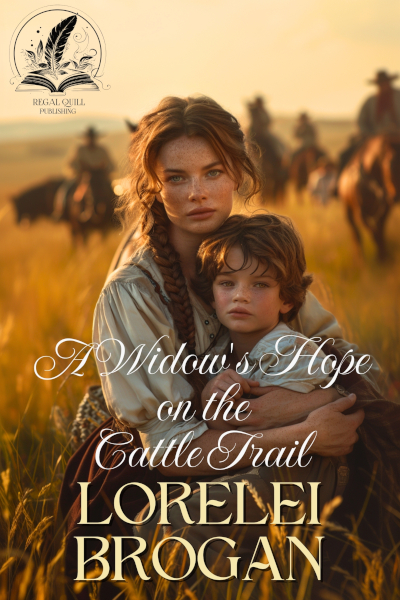
“Sir.” Mrs. Whitcomb proffered a hand. Her nails were cleanly trimmed, though he did note that some of her fingers were callused. She was dressed plain, her drab dress outlining a small frame. She’d chanced the brutal Texas sun without a hat or bonnet. Strands of auburn hair escaped her braid. Her face was tanned, with a dusting of freckles sheltering on her cheeks and the bridge of her nose.
Despite her small stature, her chin tilted up defiantly. She dropped her hand when Caleb didn’t move to shake it. She opened her mouth and had that look of a woman desperate enough not to take no for an answer. She didn’t get a word out before her scamp of a child, a little boy likely no more than five or six, in dusty trousers and a stained shirt, surged forward.
The child raced straight up to Thunder without a care for his safety. The boy’s hands shot out, reaching up for Thunder’s soft, velvet muzzle.
Caleb quickly stepped into the child’s path. Thunder liked Caleb well enough, but she wasn’t prone to sharing her love around. She was a loyal beast, much to the chagrin of anyone who had to deal with her or attempt to care for her. She would never be as mean as Horace’s nag, but she had her peculiarities.
Getting rushed up on was not something that Thunder tolerated, no matter how small the body.
“An Appleswoosa,” the boy said, mangling the word. “She’s beautiful, sir. Can I pet her?”
He was missing a few teeth in the front, but that didn’t stop the child from letting loose a huge smile. He was all towheaded, dirt-smeared innocence. Caleb’s imposing stature stopped men clean in their tracks, but this child beamed at him fearlessly.
For a horrible second, Caleb’s throat blocked up and his eyes prickled.
He’d been made to do monstrous things. Seen things that had stained his soul. He was likely more animal than man, and what man was left in him was just about entirely broken.
This boy didn’t see any of it. It was a long time since anyone had bothered to look at Caleb that way, and it did something to his insides that he wasn’t sure he could explain.
“Does she have a name, sir?” the boy asked eagerly, trying to dig a response out of Caleb as he tried to dodge past.
“Thunder,” Caleb muttered. “She doesn’t like getting petted, I’m afraid.”
The boy shrugged, made to walk back to his mother, then darted around Caleb fast as a darned lightning strike. The boy held out his tiny hand to Thunder. She looked to be about a hundred times the child’s size, but she bent her head and those soft nostrils huffed out a puff of air against the boy’s palm. He laughed, then stroked his hand up Thunder’s white spot.
“Henry!” Mrs. Whitcomb was suddenly there, edging up cautiously. “I’m so sorry,” she whispered to Caleb. “He’s enthralled with horses. Has been since he could walk and talk. His pa was a… a hand. He carved horses for Henry, and told him all those stories. I apologize, he doesn’t have a proper sense of caution, no matter how hard I’ve tried to instill one.”
Henry finally turned and seeing his mother’s half-fearful, half-livid expression, offered her his hand to his ma instead. Thunder chuffed happily behind Henry, then nudged the boy’s back with her snout like she wasn’t quite finished with him yet.
Caleb’s jaw dropped.
“I’m a seamstress,” Mrs. Whitcomb explained as she tucked Henry against her side.
Some women would have shied from Caleb, especially when he had an expression that said he didn’t want to be bothered. There were men who couldn’t quite manage to look him in his cold gray eyes. Here he was, a head taller and twice as broad as Mrs. Whitcomb, but she wasn’t going to let him go without having her say.
“I know this is quite a poor introduction, and if you’ve read me to be desperate for a position, I am. I’m not ashamed to admit it. I’ll work harder than anyone on your team. I grew up mostly poor and I’m no stranger to hard work. I’ve seen a great deal of this country, moving around with my husband. I’m certainly tougher than I look. I might be small, but that just means that I don’t eat much. I was trained by my ma and I’ve been sewing since I was a little girl. That makes twenty-odd years now. I was a schoolteacher once, and then I was a nurse of sorts in—in another lifetime.”
Caleb knew exactly what that lifetime was, or at least, he could take a good guess. Mrs. Whitcomb wasn’t about to let him get a word in until she’d had her say.
“I won’t give you any cause to regret me joining, if you take me on. Not one single one, I swear. I can help with doctoring, or with cooking, or laundry. Whatever else needs doing. My son won’t be a problem. He can help with the cooking and the laundry as well, or small chores. Firewood, or picking up chips, or…” She finally trailed off.
Unfortunately, Horace happened to amble up behind Caleb. “Doc!” Horace boomed. “You’ve done gone and found us a seamstress and a laundress in one shot! Who says that miracles aren’t real? You couldn’t have better timing, the both of you. We’re leaving morning after next, if all goes well. Hire them on, Caleb, and let’s get to work. Sooner we finish here, sooner we’re on our way.”
Caleb closed his eyes so he wouldn’t have to see the desperately hopeful expression burning in Mrs. Whitcomb’s soft green eyes.
“That’s the boss’ version of agreement,” Horace said. He spat into the dirt, grinned a yellowed, gap-toothed smile at both women, then doffed his hat to Henry.
The boy stared up at the man, absolutely magnetized.
And the woman? She was all shining-eyed, eager politeness. Just enough sweetness and naivety left in her that she’d be no match for the hard trail, no matter what she’d already endured. She was beautiful, and that was a fact. A fact which made her exactly the kind of woman Caleb didn’t want to have along.
He was far from a cruel man, but he didn’t have time to be watching out for a woman and a kid. Caleb supposed that if Mrs. Whitcomb became a problem, he could leave her and her boy somewhere. A fort, or near some small fledging town that had sprung up on the plains, clapboard eager and whitewash fresh. Caleb could give the woman some money, maybe more than her wages, and wash her from his mind.
It wasn’t that Caleb didn’t want to help, but there were widows and orphans aplenty and not nearly enough of him to go around. He was just one man and he hadn’t even been able to save his own family or hold onto his own lands. He’d spent years yearning and fretting and only wanting to get back home. Upon finding home wasn’t so much a place as a concept, and one he wasn’t willing to shed more blood over, he couldn’t wait to get gone.
Caleb didn’t have a single other thing to add. He wouldn’t renege on the promise Horace just made. His pride couldn’t take it, darn it.
He turned, muttering under his breath, and mounted up. He wheeled Thunder away, roaring into the dust storm that was his men hard at work branding, and left Doc to sort out the details and give the women their instructions.
With any luck, Mrs. Whitcomb might see sense and change her mind, but history hadn’t shaken down on the lucky side of things for a good long while.
Caleb silently promised himself that if Horace was wrong about this, Horace would be the one regretting his hasty words and eating bad meals for half the trip.
Given that Horace was the cook, Caleb wasn’t certain how he’d stick to that promise, but by gosh, he was sure he’d make good on it.
OFFER: A BRAND NEW SERIES AND 5 FREEBIES FOR YOU!
Grab my new series, "Brave Hearts of the Frontier", and get 5 FREE novels as a gift! Have a look here!
Hello my dears, I hope you enjoyed the preview! I will be waiting for your comments here. Thank you 🙂